TL;DR
Since 2019, OpenAI and Microsoft had one of the tightest deals in tech. Microsoft supplied money, cloud infrastructure, and a route to market. OpenAI supplied the models. That arrangement helped power ChatGPT, GitHub Copilot, and Microsoft’s broader AI push. It also gave Microsoft unusual leverage over OpenAI just as OpenAI was becoming bigger, more valuable, and much more expensive to run.In April 2026, the deal changed again. Microsoft is still OpenAI’s primary cloud partner and still has access to its technology through 2032, but the relationship is no longer exclusive and OpenAI can now serve customers across other clouds.
So it is a story about AI as a real market. It talks about who owns the models, who hosts them, who sells them, and where money go.
How it started
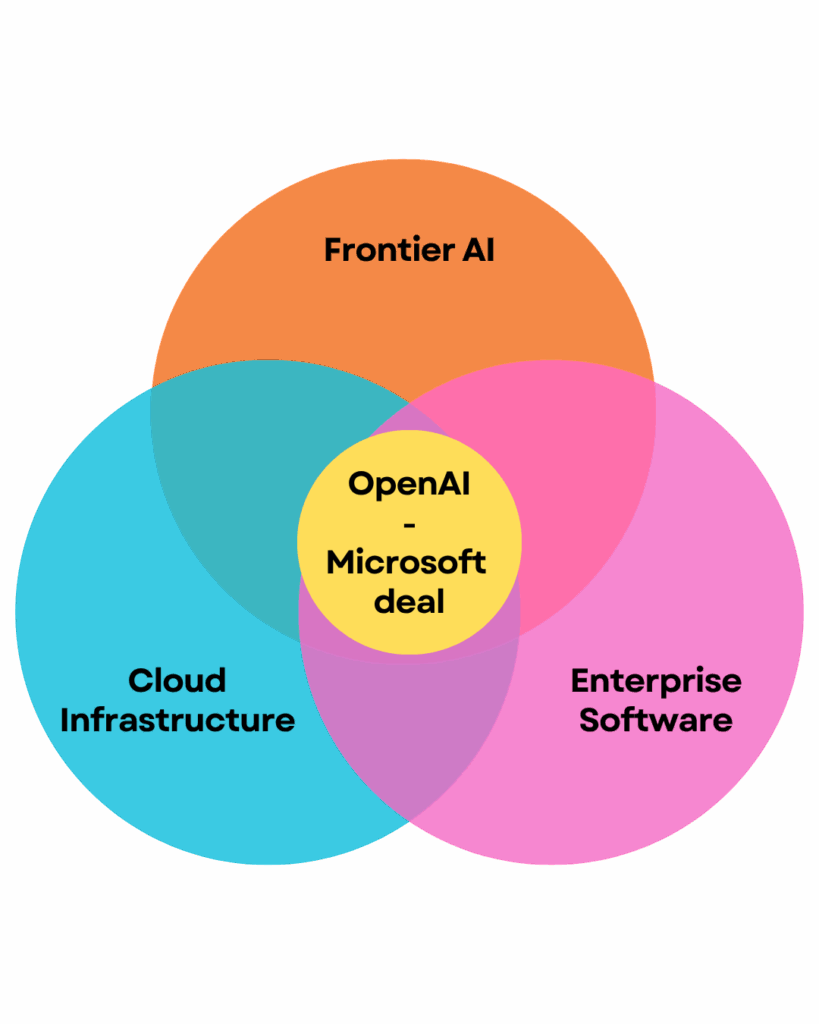
The formal relationship began in July 2019. Microsoft invested $1 billion, OpenAI moved onto Azure, Microsoft became OpenAI’s preferred commercialization partner, and the two companies agreed to build large-scale AI supercomputing systems together.
The basic arrangement was simple. OpenAI needed absurd amounts of capital and compute to train better models. Microsoft needed a believable way back into the front rank of AI and a stronger Azure story. By that time Azure was already a major cloud business, but Microsoft did not yet have the kind of frontier-model advantage that could pull customers toward its cloud the way OpenAI’s models later did. The OpenAI deal gave Microsoft privileged access to top models, let it build products on top of them, and made Azure the home of some of the most prominent AI systems in the market.
OpenAI’s reason was clear enough: training stronger models was getting very expensive, and licensing pre-AGI technology to Microsoft gave it funding without forcing it to become an ordinary software company overnight. Microsoft’s reason was strategic too. Publicly, it talked about pairing Azure with frontier AI research and building the next generation of AI infrastructure.
Later-revealed internal emails make that feel less abstract: make the competitive side much more obvious: Microsoft leaders were worried that Google was ahead in large-scale AI, and the OpenAI partnership offered a way to close some of that gap faster than building everything alone.
So from the start, this was a very ambitious arrangement built on mutual need. OpenAI needed a giant with money and chips. Microsoft needed a shortcut into a race it did not want to lose.
That deal worked. It helped OpenAI scale fast. It helped Microsoft jump forward in AI without having to catch up from scratch. But once the partnership started working at full speed, it also started creating a new problems: OpenAI’s growth was becoming too large and too complex to fit neatly inside a one-provider, highly exclusive setup.
How the deal evolved
The early period, starting in 2019, was about survival and access. OpenAI got infrastructure at a scale it could not easily build on its own. Microsoft got a privileged position next to one of the most important AI labs in the world.
The next big turn came in 2023. Microsoft described its new multiyear, multibillion-dollar investment as the third phase of the partnership, following investments in 2019 and 2021. Azure would remain OpenAI’s exclusive cloud provider. By then, OpenAI’s models were already powering products like GitHub Copilot, DALL·E 2, and ChatGPT on Azure. In short, the partnership had become part of Microsoft’s product stack.
The first real change came in January 2025. Microsoft kept the core deal in place through 2030: it still had access to OpenAI IP, still shared in OpenAI revenue, and still kept exclusive rights around OpenAI’s APIs. But (!) Microsoft got the a right of first refusal and was no longer required to supply every new block of computing capacity on exclusive terms. Instead, if it could not or did not want to, OpenAI could get compute elsewhere. OpenAI was also allowed to build additional capacity, mainly for research and training. That was an important sign that OpenAI’s needs were becoming too big for one exclusive arrangement. OpenAI needed more compute and more routes to market than the original deal easily allowed.
In October 2025 Microsoft backed OpenAI’s conversion to a public benefit corporation, disclosed a stake worth about $135 billion representing roughly 27%, and OpenAI committed to buy an additional $250 billion of Azure services. At that point Microsoft still retained exclusive IP rights and Azure API exclusivity until AGI. But it no longer had a right of first refusal on new OpenAI cloud workloads. OpenAI gained fundraising and structural headroom. Microsoft got ownership clarity and a giant Azure commitment, but not a return to full control of the cloud side. OpenAI, meanwhile, got a structure that made very large fundraising easier.
The biggest change came in April 2026. Microsoft remained OpenAI’s primary cloud partner, and OpenAI products would still ship first on Azure unless Microsoft could not, or chose not to, provide the needed capabilities. But OpenAI could now serve all its products across *any* cloud provider. Microsoft still kept a license to OpenAI’s models and products through 2032, but that license became non-exclusive. Microsoft also stopped paying a revenue share to OpenAI. OpenAI kept paying Microsoft through 2030 at the same percentage, but now with a total cap (20%). In practical terms, Microsoft gave up exclusive distribution rights and stopped sending revenue-share payments the other way, while still keeping a cut of OpenAI’s product revenue for several more years.
Why it changed
The short version is that the original arrangements started to fail as OpenAI got bigger. What made sense in 2019 became less optimal by 2025. OpenAI needed more capital, more chips, and more cloud flexibility than one exclusive arrangement could comfortably supply. Microsoft, for its part, wanted to keep the valuable rights without being forced to satisfy every new OpenAI demand on OpenAI’s timetable.
Regulators were watching too. The UK CMA described the partnership as complex and evolving, said Microsoft had held material influence over OpenAI since 2019, and examined three areas in particular: Microsoft’s investment and governance position, its supply of compute, and its IP and commercialisation rights. The CMA concluded that Microsoft did not control OpenAI’s commercial policy. But the review helps explain why both sides had reasons to make the relationship a little less intertwined and a little easier to defend.
It looks like both companies arrived at the same conclusion: they were too important to each other to split, but too big and too ambitious to stay fully exclusive.
April 2026 deal
The obvious change is that Microsoft lost exclusivity. The more interesting change is that Microsoft now depends less on formal lock-in and more on more on how deeply it sits inside the stack.
Earlier versions of the deal gave Microsoft power through explicit control points: exclusive cloud status, exclusive API positioning, and strong rights around OpenAI IP. The newer version gives Microsoft less formal control. But Microsoft is still at the center of key pieces: Azure, Copilot, and a large ownership stake. That is weaker on paper, but in practice it may still be hard to dislodge. => Microsoft’s position is still strong.
The April 2026 deal also removes some of the more unusual contract logic that had built up over time. Older versions of the relationship relied heavily on AGI-related triggers. The new one uses timelines, caps, and defined rights. That makes the arrangement easier to understand, easier to value, and probably easier to navigate when disagreements come up. It does not prove that both parties expect AGI in the near future. But it does suggest they would rather not have so much of a very large commercial relationship hanging on a single, hard-to-define milestone.
And the next argument may not be about training compute at all. It may be about distribution. Once OpenAI can serve customers across any cloud, the main question becomes who owns the enterprise front door: Microsoft, through Azure and Copilot, or OpenAI, through direct relationships spread across multiple clouds. That is where this starts to shape the wider AI and cloud markets.
Who benefits now
OpenAI comes out of the latest deal with more room to move. It can diversify compute, negotiate with more than one infrastructure partner, and reduce the risk that one company can bottleneck its growth. That does not make OpenAI independent of Microsoft, but it does make the relationship less confining.
Microsoft still keeps a lot of what matters. It has access to OpenAI’s models and products through 2032, remains the primary cloud partner, continues to receive revenue-share payments through 2030, and still benefits through its large equity stake.
So the trade-off is fairly clean. OpenAI gets more freedom, but also a more complicated life across clouds and partners. Microsoft gives up some control on paper, but keeps much of the practical advantage. And both reduce the risk of a dramatic breakup without really becoming free of each other. Now it’s the relationship that is no longer exclusive, but the wires are still very much connected.
So we have:
-Microsoft is still a major shareholder in OpenAI.
-Microsoft is still OpenAI’s primary cloud partner.
-OpenAI is still a huge customer of Microsoft’s cloud, with the October 2025 Azure commitment sitting on top of the earlier relationship.
-Microsoft still has a long-dated license to OpenAI’s models and products through 2032.
-The relationship has already been rewritten several times in a short period – January 2025, October 2025, April 2026, each time relaxing one part of the arrangement while preserving another.
We clearly see movement towards less exclusivity, more optionality to a relationship that looks increasingly like a large strategic supplier-customer-investor tangle rather than an exclusive alliance. We can expect more rewrites at pressure points, such as compute, revenue share, IP access, distribution rights. Microsoft will try to keep its practical advantage even without exclusivity. OpenAI will try to make sure no single partner can set the limits of its growth.
What to watch
Does Microsoft keep building more of Copilot and Azure around OpenAI, or does it hedge harder with in-house and other model options? That will tell whether Microsoft sees OpenAI as a long-term anchor or as a partner it increasingly needs to hedge against. Microsoft is likely to keep OpenAI central in customer-facing products where OpenAI remains strongest, but hedge harder over time with its own models and a broader model portfolio.
How quickly does OpenAI really diversify across clouds? The new terms let it serve products across any cloud provider. There is already evidence that this is very real option: Amazon and OpenAI announced a strategic partnership in February 2026 under which Amazon would invest up to $50 billion in OpenAI, AWS would become the exclusive third-party cloud distribution provider for OpenAI Frontier, and OpenAI would expand its AWS commitments. The real question now is whether major enterprise deployments start appearing outside Azure at meaningful scale. The answer is: very likely, yes.
Who ends up owning the customer relationship? Near term, Microsoft still has the stronger grip because it already owns so much enterprise workflow through Microsoft 365, GitHub, Windows, Azure, and Copilot. Longer term, OpenAI has a real shot to weaken that if it keeps expanding direct enterprise channels across multiple clouds and if products like Frontier become important enough to stand on their own.
So the next move for OpenAI will involve making multi-cloud option more concrete and harder to reverse. And Microsoft will increasingly present itself as a platform that can mix OpenAI models with its own and others’.
Sources
The next phase of the Microsoft-OpenAI partnership
OpenAI shakes up partnership with Microsoft, capping revenue share payments
The next chapter of the Microsoft–OpenAI partnership
Microsoft’s OpenAI investment was triggered by Google fears, emails reveal
Microsoft invests in and partners with OpenAI to support us building beneficial AGI