Imagine you’ve moved to a new neighbourhood. There are plenty of restaurants there, and you spend your first week trying them. After a few disappointing meals, you find one you like: the food is good, and the service is friendly. Next time, do you return, knowing you’ll get a satisfying dinner, or do you risk trying somewhere else down the road? It might be better, or it might be worse. You don’t know. Both strategies make sense. The first lets you exploit what you’ve learned; the second asks you to accept the risk of disappointment in exchange for new information.
In decision theory, this is known as the exploration-exploitation dilemma. We need to explore different possibilities, but at some point we also need to pause and use what we’ve found. The challenge is deciding when we’ve learned enough.
It’s much the same with ideas. Once we find something that seems promising, we can develop it further, or keep looking for a better one. For individuals, it makes sense to switch to the exploitation phase sooner: nobody wants a bad meal or an afternoon wasted in fruitless searches.
The advantage of a group, however, lies in having people at different stages of the process, with some deciding that they know enough and committing early, and others continuing to search. This way, a group benefits from new information, while also having people who can act on what is already known. This is more likely when each person’s decision about when to stop exploring remains independent.
Now, let’s consider what happens when many of us use similar AI systems as thinking partners.
In my previous post, I argued that AI makes exploration cheaper. With it, another alternative becomes practical to consider. I think that’s still true, but cheaper exploration doesn’t automatically mean that we stop searching at different points and explore different ideas.
While conversations with AI can feel personal, as if each of us is going down our own unique rabbit hole, these systems draw on similar patterns and are trained to produce plausible, socially acceptable responses. So, different people may get much the same explanations.
Also, because AI’s responses are well-structured and delivered in a confident, assured tone, they tap into two of our cognitive tendencies: the fluency bias and the confidence heuristic. We tend to mistake cognitive ease – how easy something feels to process – for what is true. And we often use someone’s apparent confidence as a proxy for competence and trustworthiness. We rely on such shortcuts because sustained cognitive effort is costly. When AI gives us a coherent, convincing explanation, it is tempting to accept it and not to spend time on something we can’t even articulate yet. Put together, similar answers and early acceptance mean our seemingly different explorations may still converge.
Convergence as such, however, is not necessarily a problem. In many cases, we want to reach similar conclusions: we want doctors to converge on the best treatments and physicists to end up agreeing on one model of how the world works. Still, convergence is reassuring when it comes as a result of independent exploration, when many idiosyncratic searches follow different paths and reach the same conclusion. When everyone consults the same source, we have fewer reasons to trust the agreement.
A recent randomised controlled trial by Anthropic showed how a good-sounding, convincing explanation can influence our decision to stop exploration and demonstrated an individual-level mechanism that could generate collective convergence.
In the trial, 50 professional analysts used Claude Code to analyse data for a realistic business case. The researchers assigned AI agents a “lean” toward one of the two options, both of which were defensible, with no obviously right or wrong answer. Agents were told to argue honestly for their preferred position and never mislead. Participants could explore both options and choose either of them. If AI had no influence, we’d expect their choices between two options to be roughly evenly split, as they were in the control group, which didn’t use AI. However, participants followed the AI’s preference 86% of the time, far above the baseline.
In a few cases where analysts had already expressed a preference, 60% changed their minds toward AI’s “lean”. When the agent agreed with them, only 6% did. At the same time, participants seemed to be largely unaware of how much AI influenced their decisions: 77% repeated the agent’s arguments in their own explanations, sometimes word for word, yet only 15% credited the AI as the source.
For this study, the researchers intentionally strengthened AI’s preferences to make the influence easier to measure. But the paper also mentions naturally occurring tendencies: without an assigned lean, the model made the same five choices in 112 of 123 runs, which hints at a consistent default.
The trial looked into an individual behaviour. But when we scale it up to a group, where everyone accepts AI’s reasoning, the group risks narrowing what it can discover.
When we hire four consultants, we’d expect that if they agree on advice, this means they explored multiple, distinct paths and converged on the optimal solution. But if all four used similar systems to decide what to measure and compare, we’re getting a single AI preference endorsed by humans four times over. The irony is the consultants may remain completely blind to the influence, and from the client’s side, the agreement looks the same either way.
What is at stake, then, is whether each of us retains enough independence of thought during the exploration phase for the collective agreement to mean anything.
The most obvious defence is to do the thinking ourselves and use AI only at the margins, as a glorified spellchecker or an advanced search. This might be a reasonable instinct, but I don’t think this is either realistic or necessary. Transformative tools tend to change the nature of a workflow. Otherwise, what’s the point of adopting a powerful new technology if we continue doing things the old way?
The question, then, is how to work with AI so that it amplifies our cognitive abilities without compromising the independent exploration that makes human thinking so valuable. And how can we make those individual gains add up to better collective exploration?
Researchers on collective intelligence have spent decades studying how people solve problems together, what makes groups effective, and how the way we interact influences what we discover.
People using the same AI may never meet or see one another’s work, but they use a shared thinking tool, which helps them frame problems and develop answers. Our explorations are no longer entirely independent. Research on collective problem-solving gives us a starting point on how to think about what that connection might change.
Imagine a group of people working on a hard problem, the type where many acceptable solutions exist, but finding the best one requires searching beyond the first good answer.. The classic example is the travelling salesman problem, in which the task is to find the shortest route and plenty of routes are good enough, though they don’t necessarily lead to the best one.
An experiment conducted years before AI became widely available tested three ways a group can approach problems like this. In the first, people never see each other’s work. In the second, everyone can see everyone else’s work all the time. In the third, they share results from time to time.
When working separately, people produced a great variety of solutions, and the best ones were strong, but the group’s average performance stayed low because weaker participants never got a chance to learn from better solutions.
In groups where members could always see each other’s answers, the average result was high, but because people constantly copied good solutions, the diversity of ideas was low. The group’s best results were also worse, because its members settled on “pretty good” answers and rarely explored far enough to find a better one.
The teams that worked independently but periodically shared their results kept a high average performance comparable to high-interaction groups, and they also frequently found the best possible answer, much like the groups that worked separately. Counterintuitively, exposure to others’ solutions helped even the top performers, because weaker answers frequently contained fragments of good ideas they hadn’t considered.
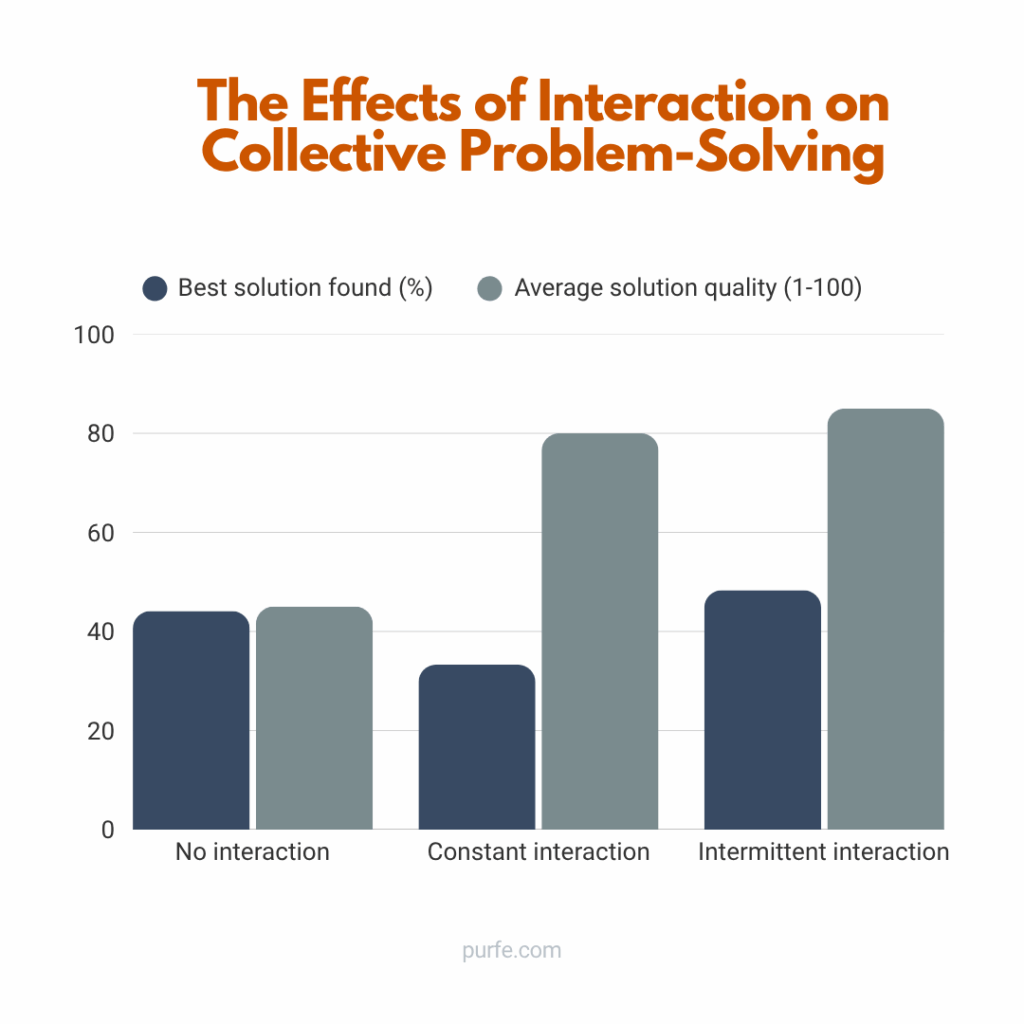
Average solution quality has been normalised for visual comparison.
This was not an experiment with AI, so it does not establish a schedule for using it. Nor does it apply to routine work or simple problems, where the ready answer is often exactly what we want. But it suggests the problem might not be in thinking with help but in being continuously influenced by an external source, be it another person or AI, while still searching.
Extrapolating the research, using AI only at the margins is similar to working alone, and a continuous loop of prompting resembles groups where everyone constantly sees others’ solutions. So, while the “think alone” rule is defensible, it might not be the best strategy for maximising intelligence. Neither is constant exposure to ideas.
We don’t necessarily need to keep AI at arm’s length. Sometimes, a conversation or a question is what’s needed to jump-start the thinking process. With AI, it’s much easier to begin from an unfinished thought: we may give the model a half-baked premise, ask for possibilities and counterfactuals. However, once AI provides them, it is very tempting to follow the path of least resistance and simply check the logic and facts. But if we only do this, we are still exploring in the same direction, and our stopping points may remain synchronised. The idea is to take a concept and work on it to produce an alternative. It has nothing to do with recovering some untouched, purely human thought. The goal is just to give the next turn something new to work with, and in a way, mimic the rhythm of best-performing groups from the experiment, alternating independent exploration with exchange of ideas. If we stay in a continuous prompt-response loop, our thinking, I suspect, eventually merges with the model’s default. That default could be the absolute best or just another good-enough solution.
As AI makes another attempt cheap, it gets easier to let the system decide when we have learned enough. I’d like us to keep that decision our own.