Approximately 4,000 years ago, a Babylonian scribe was doing something millions of us still do today – data entry. He recorded monthly grain rations for four crews on a clay tablet. Nothing particularly complicated, just simple arithmetic: multiply and add. But calculating all the amounts correctly, done four times over, required considerable effort – so much so that he apparently took a shortcut and did not cross-check the result. Four thousand years later, the tablet still bears this error.
If confirming a number he had already calculated was costly, most likely, asking more complex questions was completely out of reach. What if there had been five crews instead of four? How much would a 3% reduction in rations have saved per season? Each of these cases would have meant redoing the entire table from scratch. Ask enough “What if?” questions and the Babylonian could have spent the rest of the season answering them. The constraints of the tools he worked with limited what he could meaningfully enquire about.
Now, imagine a clerk millennia later – with pen, paper, and a calculator doing similar work. The 3% question becomes a matter of minutes. In fact, he can answer it, along with several variations, in less time than it once took the scribe to check a single column of totals. The cost of change is low enough to be worth it.
Today, we can go even further and enter all this data into a spreadsheet. Suddenly, not only can we calculate and recalculate everything much faster, but we can also begin asking fundamentally different questions and model various scenarios: from what would happen if barley prices rose by 15% to figuring out which combination of changes would maximise surplus. Exploring counterfactuals, in this case, costs almost nothing.
This is not unique to grain rations. We can recognise the pattern across domains: the range of what is possible to explore increases dramatically once the marginal cost of change becomes negligible.
We can visualise it like this:
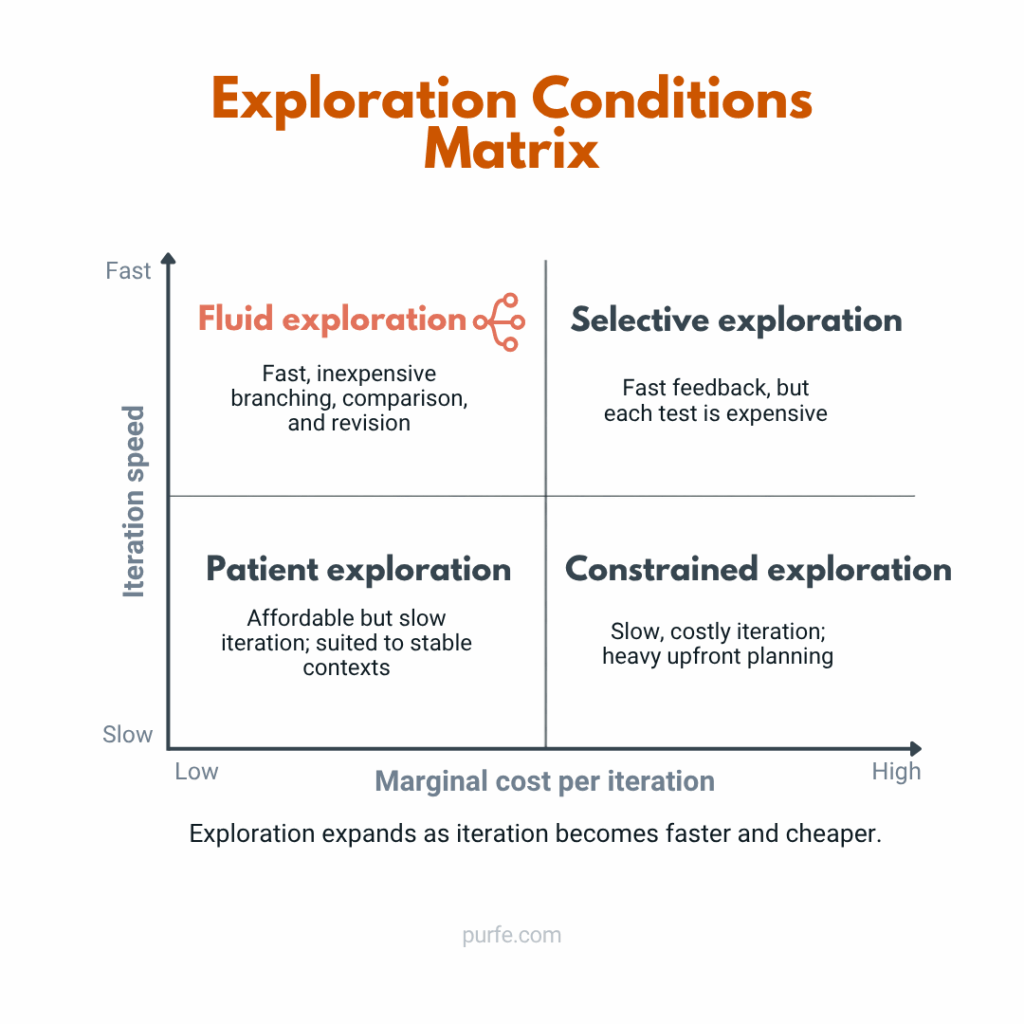
Cognitive tools, from writing to search engines, have been pushing narrow slices of thinking toward the Fluid exploration corner for millennia. AI is the first tool to push a far wider range of cognitive work there at once, making exploration practical for many different domains.
The effects of this push are visible in at least two ways: more output and more exploration.
Fast iteration speed means that work that previously took three hours can now be done considerably faster. And if producing the same result takes less time, we can make more of that. This is an output gain. Though it is worth reminding ourselves that fast does not mean good or different, and that judgment and verification still may remain expensive.
Low cost and high iteration speed also mean we can explore more ideas, test more assumptions and strategies before committing to one. This exploration of the possibility space allows us to learn more just by investigating more options, and occasionally, it can lead to unexpected discoveries. I think of this second benefit as a possibility-space gain: the increase in the quality or novelty of the best outcome made possible by a wider search.
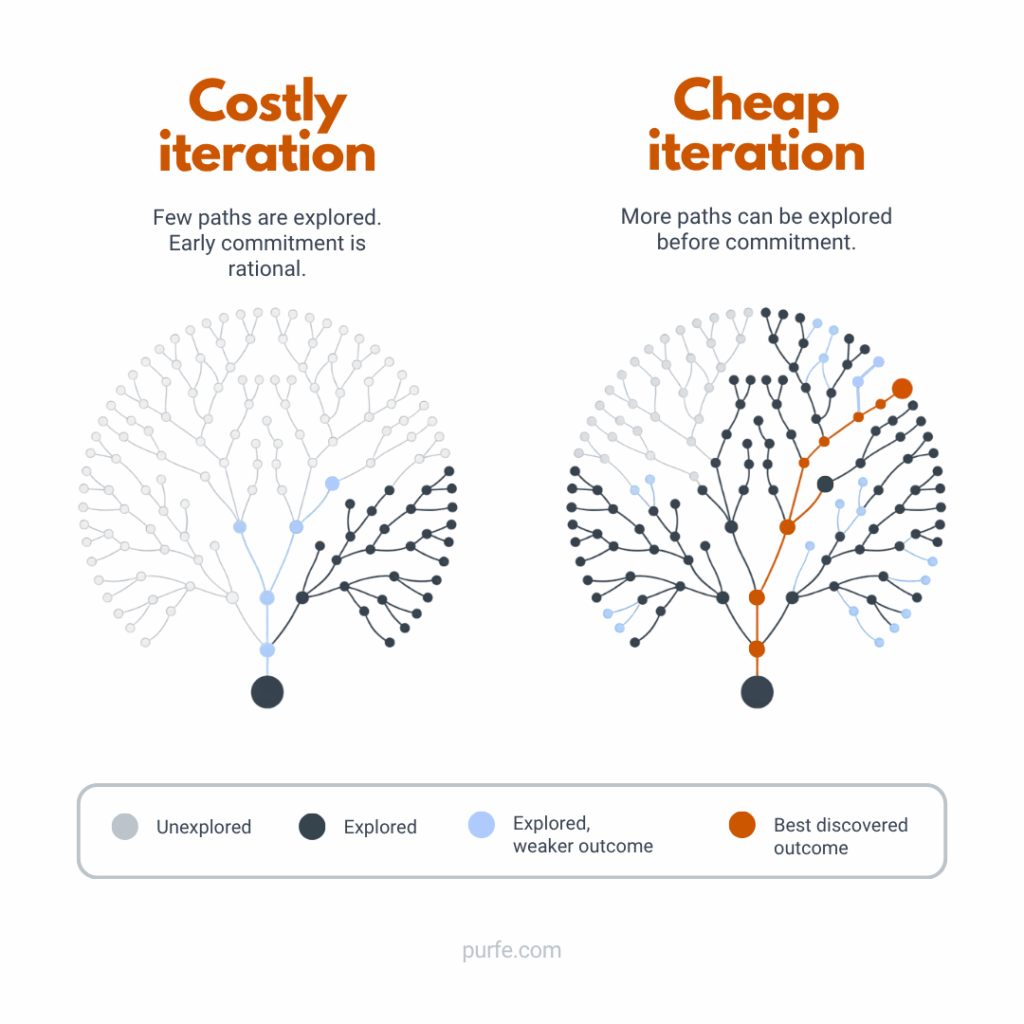
The costly iteration tree may look like a lack of imagination or intellectual laziness. In fact, it is what happens when the price of exploration is high – we become selective and explore only a few promising options; early commitment there is rational even when it results in a weaker outcome.
But every unexplored branch is a possibility that is always there, just too expensive to explore given the conditions. The Babylonian scribe could have modelled a hundred different scenarios of grain rationing by hand. It just would have cost him the rest of his life.
Today, AI changes which possibilities are cheap enough to consider, so we can ask What-if questions about almost any idea. If possibility-space gain is a real effect, we should see different or more interesting kinds of outcomes than we would otherwise expect. And there are some early signs of this already happening.
Across five million publications spanning 27 fields, a recent study in Scientific Reports found that papers combining AI and high-performance computing (HPC) were up to three times more likely to introduce novel concepts, and five times more likely to reach top-cited status than conventional research. This is not evidence that cheaper iteration produces breakthroughs. There are many possible explanations for that difference – from methods and resources to institutional context. But the finding is nevertheless a signal, at scale, that previously unexplored parts of the possibility space may be becoming accessible.
So, if something more than a productivity gain is happening, what else should we expect to see, besides access to previously unexplored possibility spaces?
Perhaps:
– expert communities start using strategies that were previously outside accepted practice;
– collaborations that could not be organised in the same way without AI;
– scientific questions becoming investigable because exploration is now feasible;
– new ways of organising, comparing, and making sense of complex information;
– cognitive workflows built around repeated human-AI iteration.
In a sense, the Babylonian tablet gives us a record of the world where checking one more answer was costly. We are beginning to leave our own record of what happens when exploring one more possibility is almost free.