Take two professionals who spent half a year using the same AI for whatever their roles require – emails, reports, programming, brainstorming, slide decks, etc. Both use it heavily every day, and one becomes better, while the other can’t do anything without it anymore. What was different?
We tend to understand thinking as an activity that we do in our heads. But actually, it is not a single indivisible process. It is made of separable parts. When we think, we do different operations, such as imagining, remembering, solving problems, forming concepts, reasoning, and judging1. And besides, not all of them always happen entirely inside our own skulls2,3.
Handing over parts of thinking to the outside world is a basic human strategy and long predates digital technology. We delegate cognitive work so we can think better and do more than our limited attention and memory would otherwise allow. This is why we take notes – they help extend our memory. To help with computation, we use calculators; to help us better visualise relationships and scenarios, we refer to diagrams and spreadsheets; for fast retrieval, we use search systems, and we certainly use other humans to help us think – to contribute knowledge, criticism, or alternative interpretations. In all these cases, we get things done by delegating parts of our thinking and not necessarily fully participating in every step of the process.
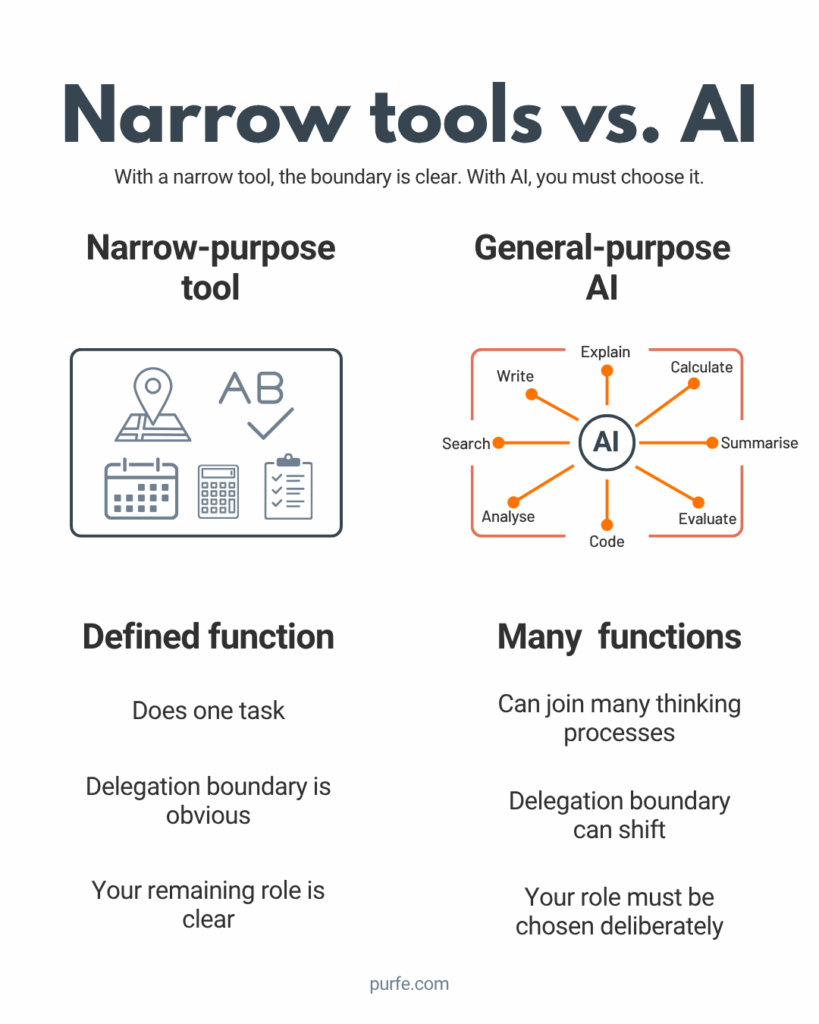
With a narrow-purpose tool, like a calculator or GPS, it is obvious what we delegate. A calculator does just one thing and one thing only – calculation. It does not express any opinion on whether your business model makes sense. The same is true with a GPS: it can find the optimal route, but it won’t question your decision to take a 40-minute detour to that bakery. Each tool has a clearly defined scope, and its job stops there. In both cases, we know exactly what we have handed over and what remains for us to do.
Things get less clear when AI comes into the picture. This is probably where the two professionals from the opening started to diverge, even though neither of them could have told you that at the time. AI is not limited to just one cognitive function. The range of processes it can participate in is enormous and includes calculation, navigation, brainstorming, explanation, evaluation, reasoning, and, to varying degrees, almost everything else we consider “thinking”. This creates a problem that narrow tools don’t: if we can delegate any part of mental activity, how do we decide which ones we should?
Current research on cognitive offloading aims to answer just that: what happens when we hand over part of our work to AI? It is very tempting to assume that the issue is which processes get outsourced, but the evidence shows that the same higher-order abilities, such as critical thinking, problem-solving, creativity, and analytical judgement, may improve with AI use in some studies4, and decline in others5.
Work on narrow tools shows the same counterintuitive result – offloading a cognitive task does not automatically mean losing the underlying skill. Calculator use, in some settings, has been associated with better mathematical skills and more positive attitudes toward mathematics6. Similarly, spellcheckers can support learning: students who use them can become better at detecting and correcting errors, and some of this learning persists and transfers to new contexts7. So what we offload cannot, by itself, explain the different outcomes. Perhaps how we offload can?
Just as “thinking” involves various separate processes, offloading also takes different forms: autonomous and dependent8. The key distinction between the two is whether AI replaces the core thinking or supports it.
Autonomous offloading happens when we stay actively involved and use AI as a scaffold for our own thoughts. In other words, it means using AI to assist us, without letting it take over the thinking process itself. People who use this type of offloading report improved cognitive performance, including deeper processing and more independent judgement.
With dependent offloading, we delegate the core work to AI and mostly accept its outputs. We may still read or edit them, but are no longer participating in the reasoning behind the answer. This type is theorised to risk cognitive deskilling and increase dependence on AI.
The problem is that the two forms can look the same from inside the moment and provide comparable immediate benefits. Both can make us feel more capable, more efficient and give us a sense of greater understanding. So we can’t immediately distinguish autonomous offloading from dependent, and even if we could, will that distinction alone be enough to tell us whether the offloading was appropriate?
This is especially important in knowledge work, where thinking is not separate from the job – it is the job. But this is also the point at which the research becomes harder to apply. Much of the studies are controlled experiments from labs and classrooms, where goals are defined in advance, and the tasks are clearly structured. Whereas, in real workplaces, the difficult part is sometimes defining what the task actually is. At work, we usually have to do a thousand things at once – meet a deadline, collaborate, develop expertise, mentor a junior colleague and so on. Those goals often conflict, because each requires different kinds of thinking, and we have only so much time and cognitive resources to spend.
Under these conditions, the distinction between autonomous and dependent offloading is no longer enough to tell us whether a particular use of AI is appropriate. If our goal is learning, then, of course, handing the routine task over to AI may remove valuable practice. But if the goal is getting that same routine task done before 5pm, offloading it is perfectly rational. Similarly, if we are asking AI to summarize a 70-page document because we need to know whether it contains a particular clause, there is no reason to independently reconstruct the document’s argument. The point is, we cannot stay meaningfully engaged with every cognitive process all the time, so we have to strategise about where our limited resources will be most useful. That is, after all, the whole point of offloading – to free up capacity for something else.
And this is also where the research framework needs to be complemented by a broader view. Autonomous and dependent offloading describe the mechanism. But real-world work requires us to make choices about what to offload and what not to. A popular suggestion is to retain “judgement” and outsource “execution.” The premise is that judgement is intrinsically valuable and more distinctly human than execution and routine work. But as we’ve seen in the example above, routine work may be exactly the type we need to do ourselves. Judgement is not sacred, and just because something involves judgement doesn’t mean AI should not touch it. What should it touch then? Unfortunately, there is no universal hierarchy of cognitive processes that tells us which forms of thinking are less critical and therefore safe to offload to AI. The choice depends on what we are trying to achieve in any particular situation. And that makes blanket advice useless.
When someone says “Never outsource judgement” – Okay, but why not? There are plenty of situations where delegating judgement to AI or an expert is exactly what you need.
“Always offload routine work” – Fine, but routine for whom? Routine work can be either meaningless overhead or deliberate practice.
“Always check the output” Check it against what exactly? If you don’t have the relevant expertise, checking becomes performative.
And suddenly, the question “What should we never outsource?” becomes the wrong one to ask.
The better one is more nuanced and complex and harder to answer: “What should this person outsource, in this task, for this purpose, given what they currently know and what they still need to be able to do?”
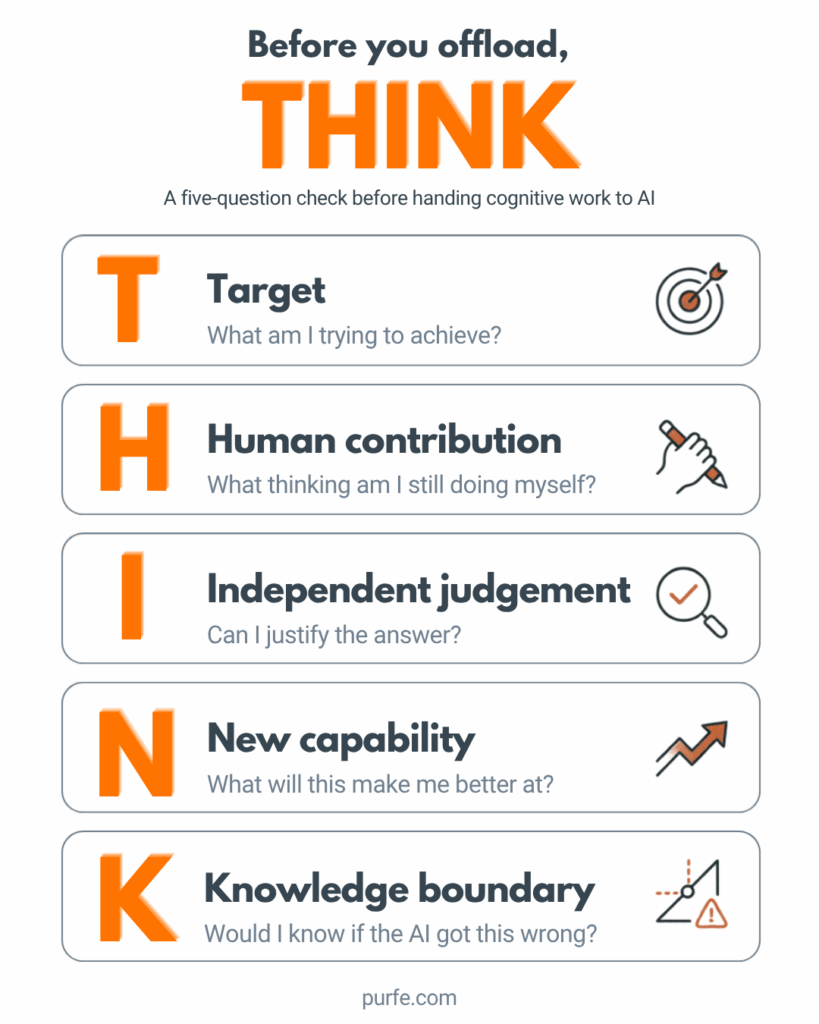
THINK is a fast way to make that decision – five checks to run before you offload on autopilot:
T: Target. What am I trying to achieve?
H: Human contribution. What thinking am I still doing myself?
I: Independent judgement. Can I justify the answer?
N: New capability. What will this make me better at?
K: Knowledge boundary. Would I know if the AI got this wrong?
The point is not to use AI less, or to keep certain types of thinking permanently off limits. AI can help with almost anything; it has an extraordinary advantage over the cognitive tools that came before it. The challenge now is to decide what we are freeing our minds from, and what we are freeing them for.
References
- American Psychological Association. (n.d.). Thinking. In APA dictionary of psychology. https://dictionary.apa.org/thinking ↩︎
- Scaife, M., & Rogers, Y. (1996). External cognition: How do graphical representations work? International Journal of Human-Computer Studies, 45(2), 185–213. https://doi.org/10.1006/ijhc.1996.0048 ↩︎
- Risko, E. F., & Gilbert, S. J. (2016). Cognitive offloading. Trends in Cognitive Sciences, 20(9), 676–688. https://doi.org/10.1016/j.tics.2016.07.002 ↩︎
- Gerlich, M. (2025). From offloading to engagement: An experimental study on structured prompting and critical reasoning with generative AI. Data, 10(11), Article 172. https://doi.org/10.3390/data10110172 ↩︎
- Lee, H.-P. H., Sarkar, A., Tankelevitch, L., Drosos, I., Rintel, S., Banks, R., & Wilson, N. (2025). The impact of generative AI on critical thinking: Self-reported reductions in cognitive effort and confidence effects from a survey of knowledge workers. In Proceedings of the 2025 CHI Conference on Human Factors in Computing Systems (pp. 1–23). Association for Computing Machinery. https://doi.org/10.1145/3706598.3713778 ↩︎
- Ellington, A. J. (2003). A meta-analysis of the effects of calculators on students’ achievement and attitude levels in precollege mathematics classes. Journal for Research in Mathematics Education, 34(5), 433–463. https://doi.org/10.2307/30034795 ↩︎
- Lin, P.-H., Liu, T.-C., & Paas, F. (2017). Effects of spell checkers on English as a second language students’ incidental spelling learning: A cognitive load perspective. Reading and Writing, 30(7), 1501–1525. https://doi.org/10.1007/s11145-017-9734-4 ↩︎
- Zhu, Q., Li, X., Dong, Y., Chang, P., & Fan, M. (2026). Not all cognitive offloading is equal: Distinguishing dependent and autonomous offloading to generative AI. Frontiers in Psychology, 17, Article 1878629. https://doi.org/10.3389/fpsyg.2026.1878629 ↩︎